
Resource
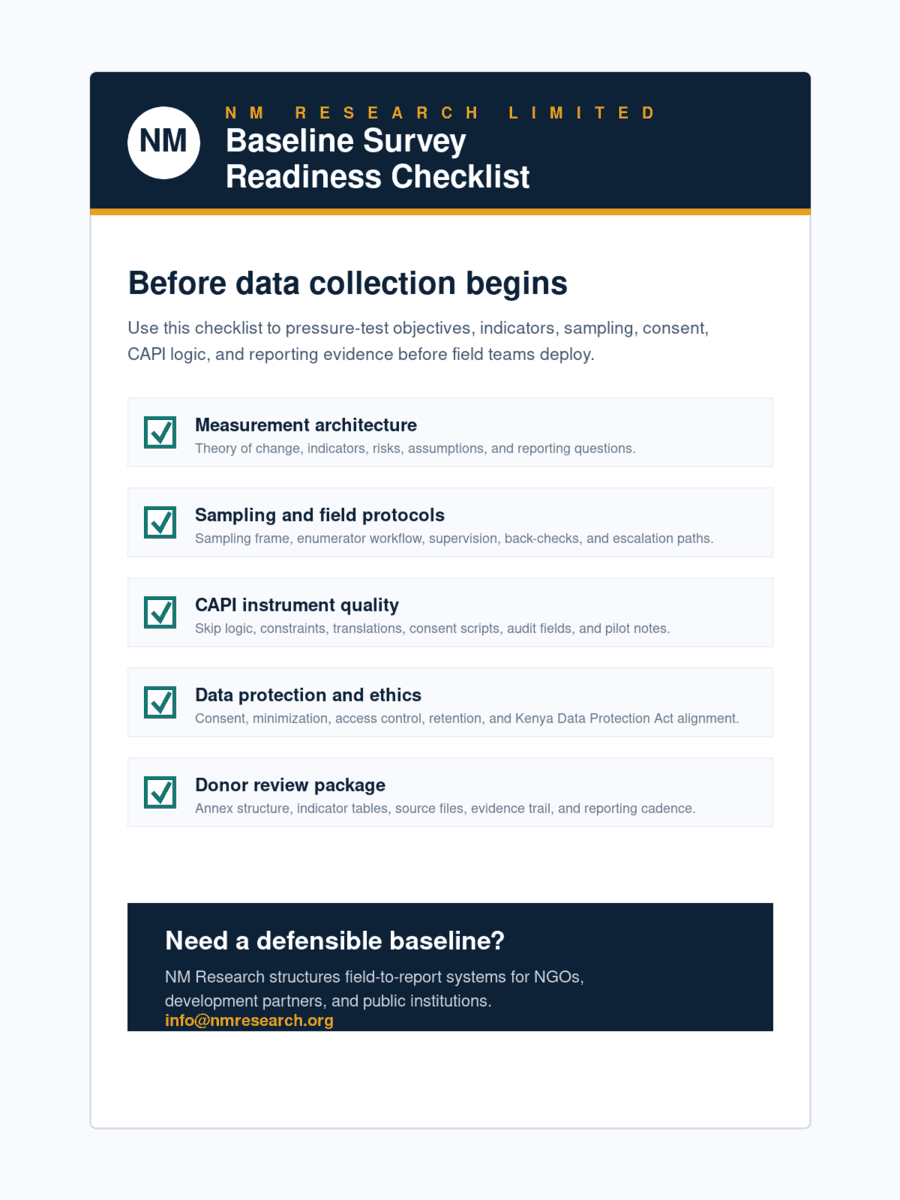
Baseline Survey Readiness Checklist
Use this checklist to pressure-test objectives, indicators, sampling, consent, CAPI logic, and reporting evidence before field teams deploy.
Donor context: USAIDDonor context: EUDonor context: FCDO
Context tags indicate reporting alignment or funder familiarity; they do not imply donor endorsement.
How to use this checklist
Work through each section before field deployment. Items marked (Critical) must be resolved before approval to proceed. Use the notes column to log the responsible person and target resolution date.
Section 1: Objectives and Indicators
- Study objectives are documented and approved by the programme team
- Each objective maps to at least one measurable indicator (Critical)
- Indicators distinguish baseline from endline reference points
- SMART criteria applied: Specific, Measurable, Achievable, Relevant, Time-bound
- Disaggregation variables defined (sex, age group, geography, wealth quintile)
- Data source for each indicator is confirmed and accessible
- Indicators align with donor reporting requirements (Critical)
- Composite or proxy indicators are documented with construction notes
Section 2: Sampling Design
- Target population is precisely defined
- Sampling frame is available, current, and verified (Critical)
- Sample size calculated with power analysis (minimum detectable effect documented)
- Stratification variables are identified and justified
- Sampling method selected: simple random / stratified / cluster / multi-stage
- Replacement procedure for non-response is documented
- Oversample buffer applied where non-response rate > 10% expected
- Geographic coverage maps to programme intervention boundaries
Section 3: CAPI Instruments and Logic
- Survey instrument version control in place (version number, date stamp) (Critical)
- All skip logic paths tested with representative cases
- Constraint messages are clear and actionable for enumerators
- Required fields marked; optional fields flagged separately
- GPS capture enabled for all household visits
- Timestamp capture enabled for start and end of each interview
- Pilot test completed with minimum 20 cases
- Pilot findings documented and instrument revised accordingly (Critical)
- Offline sync tested in low-connectivity conditions
- Data submission to server verified end-to-end
Section 4: Consent and Ethics
- Informed consent script approved by lead researcher (Critical)
- Consent script available in all required local languages
- Verbal consent procedure documented for low-literacy populations
- Data storage and retention policy documented
- Sensitive data fields identified and encryption confirmed
- Respondent anonymisation procedure documented
- Ethics clearance obtained or exemption documented (Critical)
- Vulnerable populations protocol in place (children, displaced persons, etc.)
Section 5: Enumerator Readiness
- Enumerator selection criteria documented and applied
- Training agenda finalised (minimum 2 days for complex instruments)
- Role-play exercises included in training design
- Supervisor-to-enumerator ratio established (recommended: 1:4–1:6)
- Enumerator ID assigned and linked to CAPI login
- Daily target interview count per enumerator communicated
- Escalation procedure for field issues explained and tested
- Emergency contacts distributed to all field staff
Section 6: Field Logistics
- Field schedule finalised with geographic routing plan
- Device allocation confirmed (charged; charged spares available)
- Data backup procedure confirmed (daily sync minimum)
- Transport plan covers all clusters in sampling frame
- Per diem and accommodation arrangements confirmed
- Supervisor daily check-in schedule established
- Replacement respondent procedure communicated to supervisors
- Safety and security briefing completed for all field staff
Section 7: Reporting Evidence
- Data entry / submission workflow documented end-to-end
- QA dashboard or daily monitoring tool configured (Critical)
- Back-check sampling rate established (recommended: 10%)
- Outlier review protocol documented
- Cleaning protocol and decision log template prepared
- Final dataset variable dictionary drafted
- Reporting timeline communicated to programme team
- Handover format agreed with client (cleaned data, codebook, field report)
Sign-off
| Role | Name | Date | Approved |
|---|---|---|---|
| Lead Researcher | ☐ | ||
| Field Supervisor | ☐ | ||
| Programme Officer | ☐ |
For advisory support on baseline design, contact NM Research and Advisory.